Learning Center
An Introduction to Vinyasa Flow Yoga
Vinyasa flow is a modern style of yoga that links poses into a smooth sequence, with each movement timed to an inhale or an exhale. It comes from the teaching of T. Krishnamacharya and Ashtanga yoga, and it suits people who like to keep moving; beginners do best in a class labeled beginner or slow flow.
Vinyasa yoga, often called "flow" or "vinyasa flow", is a modern style that grew out of traditional hatha yoga. Instead of holding each pose and resting in between, you move from one pose to the next in a smooth sequence, with each movement timed to an inhale or an exhale. The Sanskrit word vinyasa is usually translated as "placing in a special way", which describes how each movement is placed on the breath.
Where it comes from
The flowing style traces back to T. Krishnamacharya, who taught in Mysore, India, in the 20th century. His student K. Pattabhi Jois developed Ashtanga vinyasa yoga, a fixed series of poses linked by breath, and teachers in the West later loosened that into freer sequences that change from class to class. That's what most studios now call vinyasa flow. (The ancient Yoga Sutras of Patanjali, often quoted in class, say very little about postures; flowing sequences are a much more recent development.)
How a vinyasa class works
The teacher cues a movement on each breath: "inhale, reach up; exhale, fold forward". Many classes use sun salutations to warm up, then build to standing poses, balances and twists, and slow down at the end with seated stretches and a final rest. Because you keep moving, vinyasa warms you up and works your strength and stamina as well as flexibility. Some classes are gentle; others, often called power yoga or hot vinyasa, are demanding.
Keeping the breath steady is the hardest part at first. The mind tends to race ahead. With practice, matching breath to movement becomes easier, and many people find that's what makes vinyasa feel like a moving meditation.
A simple sample flow
Here's a short, simple sequence. Move slowly, and if any pose hurts, come out of it.
- Start standing in mountain pose (tadasana), feet hip-width apart.
- Inhale and bend your knees into chair pose (utkatasana), arms up.
- Exhale and fold forward (uttanasana).
- Inhale and step your left foot back into a low lunge.
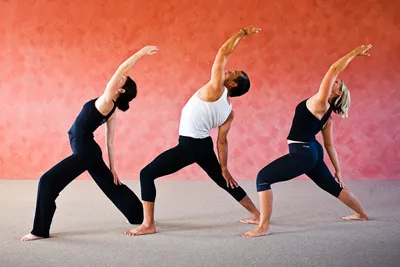
- Exhale, turn your back heel down and come into extended side angle (utthita parsvakonasana), right forearm on your right thigh.
- Stay for 3 slow breaths.
- Inhale, straighten your front leg, and on the exhale come into triangle pose (trikonasana).
- Stay for 3 slow breaths.
- Exhale, turn to face the front of your mat and bring your hands down beside your front foot.
- Inhale into a lunge, back heel lifted.
- Exhale, step back into downward-facing dog (adho mukha svanasana).
- Stay for 3 slow breaths.
- Exhale and lower your knees, chest and chin to the mat (ashtangasana, the eight-limbed pose).
- Inhale into cobra (bhujangasana).
- Exhale back to downward-facing dog.
- Inhale and walk or step your feet to your hands.
- Exhale and fold forward.
- Inhale, rise slowly to mountain pose, then repeat on the other side.
What it can do for you
People who practice vinyasa regularly often say they feel calmer, sleep better and get stronger and more flexible. Research on yoga in general backs some of this: the US National Center for Complementary and Integrative Health says yoga may help with stress, balance, sleep and some kinds of pain, and may ease anxiety and depression symptoms alongside other care. Our article on the benefits of vinyasa flow yoga sorts what's proven from what isn't.
If you're new to yoga, start with a beginner or slow-flow class, or a slower hatha class, so you learn the poses before you speed up. Many retreats in Costa Rica teach vinyasa every day; see our guide to choosing a yoga retreat in Costa Rica.
Frequently asked questions
What does vinyasa mean?
It's a Sanskrit word usually translated as "placing in a special way". In yoga it means linking each movement to the breath in a continuous sequence.
Is vinyasa the same as Ashtanga?
Not quite. Ashtanga follows a fixed series of poses in the same order every time. Vinyasa flow uses the same breath-linked movement but the sequence changes from class to class.
Is vinyasa hard for beginners?
It can be, because it moves quickly. Look for a class labeled beginner or slow flow, and rest in child's pose whenever you need to.
[Updated on: 4 November 2026]